
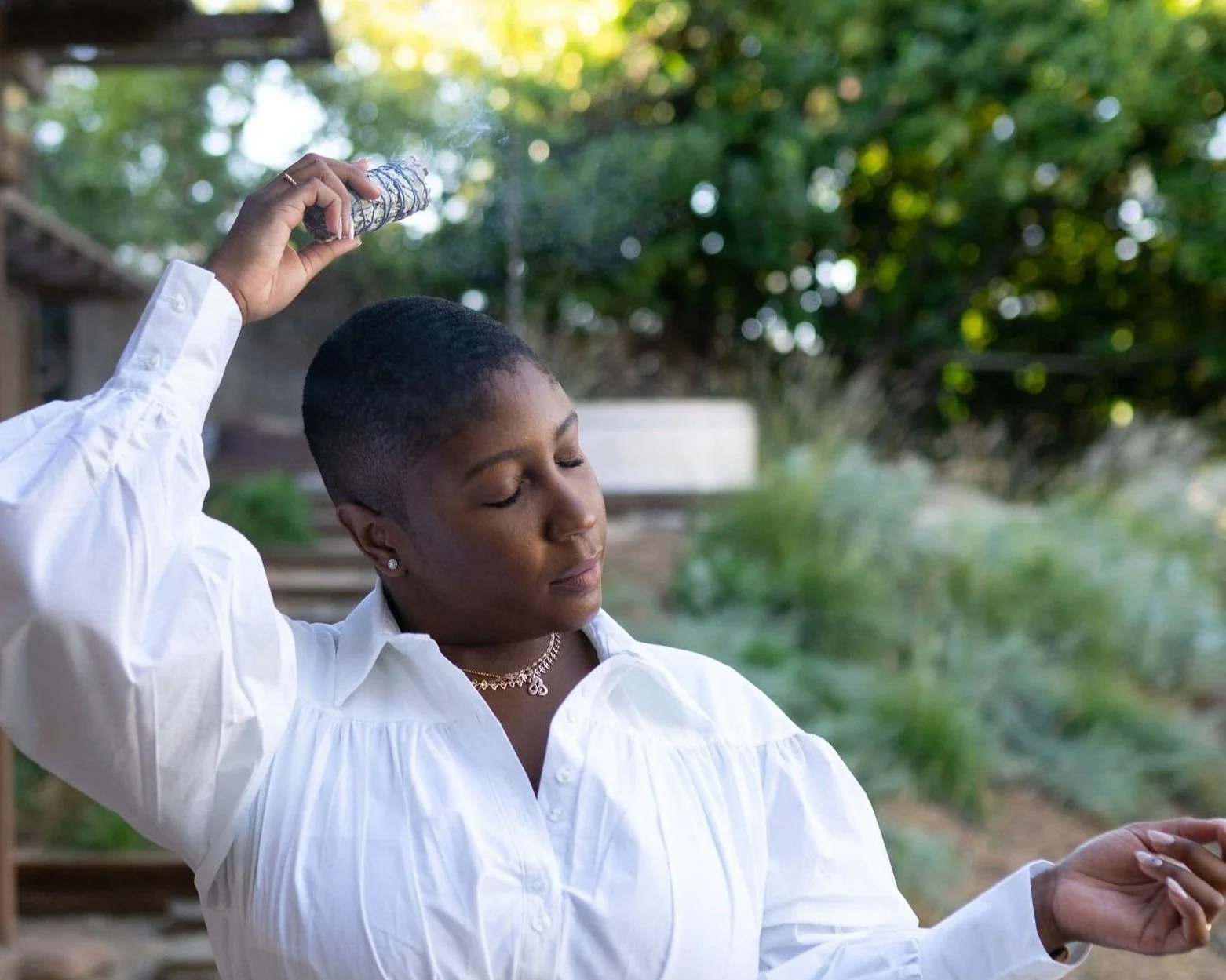
Wholeness is what happens when you stop fragmenting yourself and start operating from your full, Divine truth.
The Foundation
My work is rooted in the theological belief that we were created in the image of God. In so being, we have been imbued with Divine, God-like qualities.
Though we are not God, we are still of God, and in being of God, we are simultaneously blessed and tasked with the ability to co-create that which we want to see in the world, or to help create new worlds entirely.
The challenging thing, however, is that we, especially those of us from marginalized backgrounds, namely Black women, have been taught that not only are we not of God, but that we are entirely separate from God.
This separation from God (Source, Universe, The Divine) and the God that exists within us keeps us disembodied, disoriented, and disconnected from the truth of who we are. This separation is the source of fragmentation for those of us who have not yet learned to define and know God for ourselves and see ourselves as being of God.
The Why
Unfortunately, this separation ideology has served as the bedrock upon which systems and societies of oppression, exploitation, extraction, and great harm have been built. After all, it is much easier to subjugate people who are spiritually fragmented than those who are whole.
For far too long, these harmful systems have capitalized on our energy, essence, and ineffable nature to create new worlds, only to push us to the margins and systematically exclude us from the very benefits of the worlds we were forced to create.
My Solution
My work takes the form of spiritual and societal justice that seeks to right these wrongs on both ends: bringing the marginalized back into a sense of spiritual wholeness and shaping new systems that not only hold but also value that wholeness.
When we introduce systems and structures of nurturance, care, and belonging, everyone can operate from and as their highest, most Divine selves, thereby moving themselves, cultures, and societies forward.
My Conviction
Why am I so sure?
Because as a Black woman, I sit at the intersection of several marginalized identities and thus have a deeply intimate and personal understanding of what it means to be excluded, as well as what it means to belong.
Given my personal and professional experiences, I carry the clearest vision of where and how systems fail (even those with the best intentions) and possess the blueprint to build systems that serve the good of all.
I invite you to imagine a world where we can ALL freely exist as the highest, most authentic version of ourselves.
Can you imagine the families, societies, systems, structures, worlds, and realities that we could collectively create?
Let’s build this world rooted in individual and collective wholeness, together.
The women, founders, leaders, and executives I work with have spent far too many seasons living from a place of fragmentation.
Split across too many roles, they’ve grown disconnected from their most authentic selves, from intimacy in their most important relationships, and from communities and cultures that accept all of who they are without shrinking, shape-shifting, or code-switching.
They are accomplished, purpose-driven, and know that the next stage of their becoming requires reconnection.
My wholing work brings them back into that reconnection using three inseparable sources of wisdom.
SOURCE ONE
Mindfulness as a spiritual and sacred practice that connects a person to their inherent divinity.
The Sacred
SOURCE TWO
Nervous system regulation, breathwork, and body-mind awareness practices that restore presence and inner safety.
The Somatic
SOURCE THREE
The evidence and research that confirm well-being emerges from the dynamic relationship between the brain, the body, and the environments we inhabit.
The Scientific

QUESTIONS & ANSWERS
-
Wholing work is my term for the process of returning to wholeness — not as a destination you arrive at once, but as a continuous practice of integration. It is the work of identifying where fragmentation lives in your body, your spirit, and your sense of self, and intentionally moving toward reconnection. It is not therapy, though it is therapeutic. It is not religion, though it is rooted in faith. It is the practical, embodied, spiritually-grounded work of becoming more fully yourself.
-
Mindfulness has deep spiritual and cultural roots that predate its popularization in Western wellness culture. To teach it without honoring those roots, solely reducing it to a stress management tool or a productivity hack, would be a disservice to the tradition and to the people I serve. That said, how I introduce and apply mindfulness varies by context. In my individual coaching and community work, it is practiced in its full spiritual depth. In organizational settings, I apply it in ways that are accessible and appropriate for the workplace without stripping it of its integrity or reducing it to something it was never meant to be.
-
No. While my work is deeply rooted in Black womanist thought, Black liberation theology, and the lived experiences of Black women, it was never designed to be exclusionary. As scholar and activist Tricia Hersey writes in Rest is Resistance, the idea that justice work centering Blackness is only for Black people is limiting and false. Black liberation is a global shift that benefits everyone living under the lie of white supremacy and extractive capitalism. My work operates from that same conviction. Fragmentation does not discriminate. And the path toward wholeness is one that every human being is entitled to walk. If my work resonates with you, you are welcome here.
-
My 1:1 coaching and membership community center the lived experience of Black women. Both were created as safe and sacred containers where self-identified women of the Black diaspora can heal, grow, and evolve in culturally specific and sensitive ways. If you do not identify as a Black woman and feel called to this work, I'm happy to explore what a customized experience might look like for you — one that honors your identity and feels genuinely resonant. I'm also glad to refer you to coaches who may feel more aligned.
-
You don't have to be anything but open. While faith is woven throughout my work, I approach it through the lens of Christ-consciousness: the embodiment of radical love, compassion, justice, and the deep knowing of one's own divine nature, rather than any specific religious dogma or doctrine. Whether you call it God, Source, the Divine, or something else entirely, what matters is your willingness to explore a relationship with something greater than yourself. My work draws from the teachings of Christ, Black Liberation theology, and womanism, and also includes mindfulness, meditation, and metaphysical and wellness practices. It is expansive by design. I encourage everyone I work with to take what resonates and use it to cultivate a faith and spiritual practice that feels authentically their own.
-
Yes — The Altar. The Altar is a communal space for Black women who are ready to bridge faith, spirituality, and wellness in their everyday lives. Inside The Altar, we explore what it means to build a faith and spiritual practice that feels like home, rooted in Black Liberation theology, womanism, and the wisdom of our various cultural traditions. If you are a Black woman who is spiritually curious, actively deconstructing, or simply ready to stop going it alone, The Altar was built for you. You can learn more about it here.
-
No. My organizational work does not inherently include faith, spirituality, or religion. However, because a significant part of Integrative Inclusion™ begins with you — your own regulation, leadership capacity, and well-being — there is space to incorporate faith and spirituality into that personal dimension of our work together, if it is an important part of your identity and you want it there. That remains between us. It does not carry over into the organizational culture design, people systems, or team-facing work. What shows up in the room with your people is grounded in evidence, ethics, and practice, not doctrine
-
No. My faith is personal, and I honor the full spectrum of spiritual and religious beliefs held by everyone in the spaces I'm invited into. Organizational engagements — workshops, facilitation, culture design — are rooted in somatic wellness practices and the science of organizational well-being. Where mindfulness is part of the work, I teach and practice it with integrity, honoring the ethical and cultural roots of the tradition rather than reducing it to a productivity tool. The goal is always depth, dignity, and genuine well-being, not a shortcut.
Ready to move into wholeness? Let’s have a conversation